
Staying Safe: Scams and Warning Signs
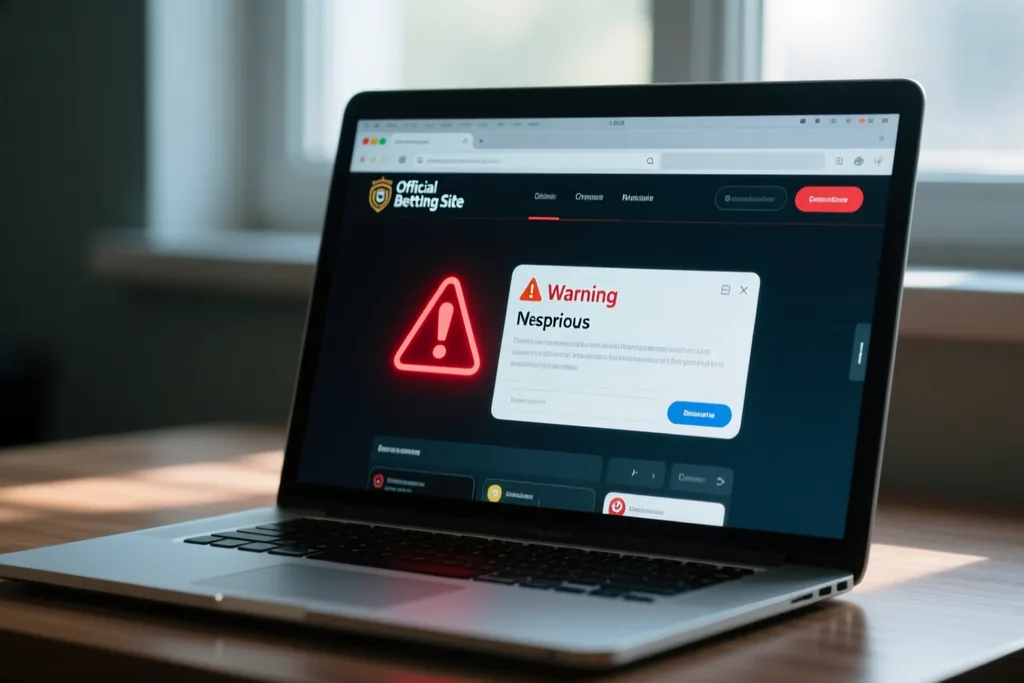
The risks around online betting are not limited to losing a stake. Some of them come from people who never intend to run a fair game at all, and their offers are usually designed to look more attractive than the real thing.
This guide describes the most common scams and the warning signs that give them away. It is information only, and it does not replace the operator's own security advice. The most useful protection is a habit of checking sources rather than trusting appearances.

Fake applications and mirror sites
A frequent scam is an application or a website that copies the look of a well-known platform but is run by somebody else. Logging in there hands over your credentials, and depositing there sends money to a stranger with no way back.
The defence is to reach the platform by the route you know rather than by a link you were given. Type the address or use a bookmark, and be suspicious of any page that appears through an advertisement or a message and asks you to sign in immediately.
Messages that create urgency
A second common approach is the message that warns, rewards or threatens in order to make you act quickly: an account about to be closed, a bonus that expires in minutes, a payment that needs confirmation. Urgency is the tool that turns caution into action.
No legitimate support team asks for a password or a one-time code. If a message requests either, it is theft regardless of how official it looks, and the correct response is to close it and open the platform yourself rather than to reply or to follow the link.
Paid predictions and fixed matches
Offers of guaranteed wins, inside information or fixed matches are as old as betting itself. They are built on a claim that cannot be true in a market priced with a margin, and they make money from the subscription rather than from the prediction.
The signs are consistent: limited places, urgent deadlines, screenshots as proof, and a request for payment through an untraceable route. Anyone able to predict outcomes reliably would have no need to sell that ability to strangers.
Protecting the account itself
Some scams aim at the account rather than the wallet. A stolen password, a shared device with a live session or a one-time code handed over in a chat can each give another person access to a balance that is entirely legitimate.
The measures that prevent this are the familiar ones: a unique password, a second confirmation step where it is offered, caution with codes, and a habit of reviewing the devices and sessions listed in the account. They are simple, and they are effective because most attacks rely on carelessness rather than on advanced skill.
A practical approach
The common thread in almost every scam is a request to trust something without checking it. Learning to slow down at that moment is more useful than memorising a list of frauds, because the specific tricks change while the underlying request does not.
The points below summarise the habits that keep an account and its balance out of the hands of others, and none of them requires technical knowledge.
- Reach the platform by a route you know, not by a link.
- Never share a password or a one-time code with anyone.
- Treat urgency as a warning sign rather than a reason to hurry.
- Ignore anyone selling predictions or fixed matches.
- Review the devices and sessions active on your account.
Scams and their warning signs
The table pairs common scams with the sign that gives them away and the simple response.
| Scam | Warning sign | Response |
|---|---|---|
| Fake app or site | A link, ad or message as the route | Open the platform yourself instead |
| Phishing message | Urgency and a request for details | Close it and verify separately |
| Paid prediction | A promise of certain wins | Treat as a fraud by default |
| Stolen code | Someone asking for a one-time code | Never share it with anyone |
| Shared device | A session left open | Sign out and lock the device |
Staying safe is less about spotting a particular trick and more about a habit: slow down whenever something asks you to trust it without checking. Reach the platform by a known route, keep credentials private, and treat any promise of a sure win as a sign of fraud. The operator's own terms and security pages set the rules, and the responsibility for checking a source belongs to the person about to hand over money.
18+. Gambling is a game of chance: no strategy, bonus or prediction guarantees a win. Every spin, card and match outcome is random and independent, odds and conditions are set by the operator and can change, and this page is information only — not advice and not an invitation to bet. Play for entertainment, use the limits and pauses available in your account, and stop if play stops being fun. Nothing here can make an outcome predictable, and past results never influence the next round. Set a budget and a time limit before you play, and treat any promise of a sure win as a warning sign.
Read next
Getting Started: A Beginner’s Guide
A calm first-session checklist, from choosing a password to setting limits.
Bonuses and Wagering Requirements Explained
How a welcome offer is read, what wagering means and when a bonus can lapse.
Responsible Gaming: Limits, Pauses and Help
Deposit limits, time-outs and self-exclusion explained simply.