
How to Make a Deposit

A deposit is the transfer of money from a payment method you control into your betting account, where it becomes the balance used to place bets or play games. It is usually the simplest operation on the platform, and also the one where small mistakes cause the most inconvenience later.
This guide explains how a deposit is normally made, what details must match and where the limits come from. It is information only. The available methods, the amounts accepted and the conditions attached are set by the operator and by the payment provider, and they can change over time.
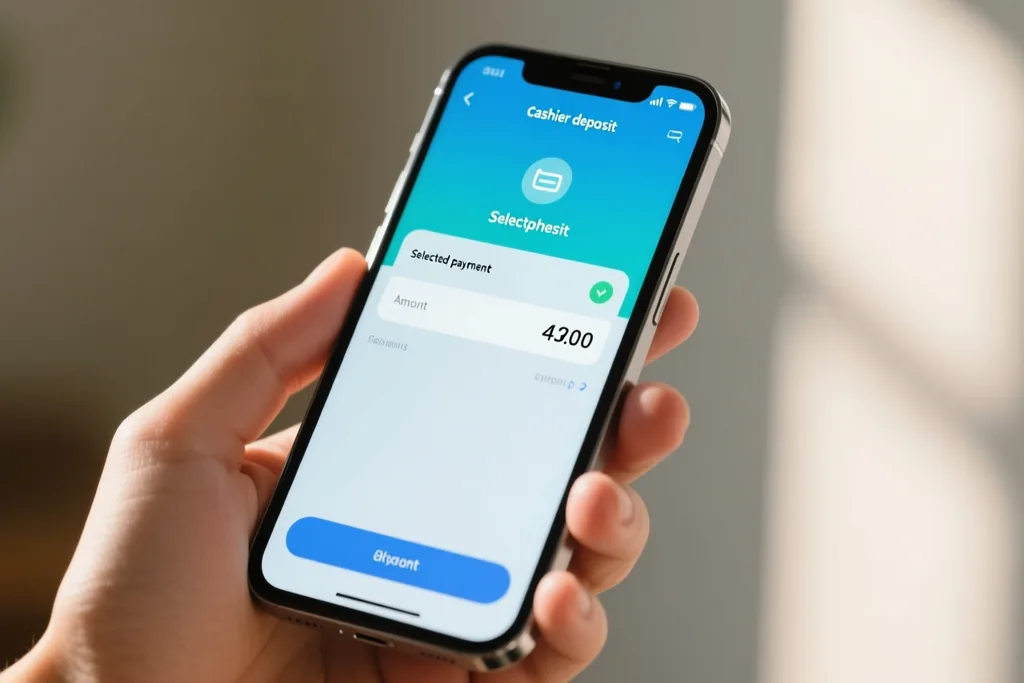
How a deposit is made
A deposit starts in the cashier section of the account, where the accepted payment methods are listed. You choose a method, enter or confirm the amount, and complete the payment through the provider's own interface. Once the provider confirms it, the balance of the account is updated.
The exact steps differ between methods, but the pattern is stable: choose, confirm, pay, wait for the confirmation. If the balance does not change immediately, the payment may still be in progress at the provider rather than lost, so checking the transaction record is the first sensible step.
Why the details must match
Payment methods are usually required to be in the same name as the account holder. A card, a bank account or an e-wallet belonging to somebody else, even a family member, creates a mismatch that most operators treat as a reason to hold a transaction and request an explanation.
This rule exists to prevent the platform from being used to move money for third parties, and it is enforced at the point of payment as well as at withdrawal. Using only instruments registered to your own name removes the great majority of deposits that later turn into a problem.
Where the limits come from
Every method carries a minimum and a maximum, set jointly by the operator and the payment provider. A minimum exists because small transfers are not economical to process, and a maximum because of the provider's own rules and the operator's risk controls.
Within those technical limits, the operator also offers account-level controls, such as a deposit limit that you set yourself. That is a different kind of limit: it is yours, it is a self-imposed ceiling, and it can usually be lowered immediately and raised only after a waiting period, precisely so that it cannot be undone in the heat of a session.
Fees, timing and points to check
Whether a deposit carries a fee depends on the method and the provider, and it is shown before the payment is confirmed. The speed of crediting also varies: some methods are near-instant, while others can take longer because of their own processing.
It is worth reading the operator's payment page before the first deposit, so that the conditions are known in advance rather than discovered when a transaction goes wrong. The points below are the ones that most often affect a deposit in practice, and none of them concerns the outcome of any bet.
Before you pay
A short check before confirming a payment prevents most deposit problems. Verify the method, the amount and the name on the instrument, and note that the transaction will appear in your account history for later reference.
A deposit only moves money into the balance; it does not commit you to playing or betting, and it does not affect the outcome of anything. Keeping the amount within a planned budget is the simplest way to keep the balance a means rather than a target.
- Use only payment methods registered in your own name.
- Check the minimum and maximum for the chosen method.
- Read whether the method carries a fee before confirming.
- Keep the amount inside the budget you planned for the month.
- Save the transaction reference in case a query arises.
Deposit essentials
The table sums up the elements of a deposit and what each one depends on.
| Element | What it involves | What it depends on |
|---|---|---|
| Choice of method | The accepted options in the cashier | Operator and provider availability |
| Amount | Between the minimum and the maximum | Provider rules and account limits |
| Details | The name on the instrument | Must match the account holder |
| Timing | When the balance is credited | The method and the provider |
| Fees | A charge for the transfer, if any | Shown before confirmation |
A deposit is a transfer into a balance, not a stake and not a step towards a win. The method, the limits and the conditions belong to the operator and the payment provider and can change, so the cashier page that is shown at the moment of payment is the one that applies. Use your own payment instruments, keep the amount within a plan, and treat the balance as money to be managed rather than spent.
18+. Gambling is a game of chance: no strategy, bonus or prediction guarantees a win. Every spin, card and match outcome is random and independent, odds and conditions are set by the operator and can change, and this page is information only — not advice and not an invitation to bet. Play for entertainment, use the limits and pauses available in your account, and stop if play stops being fun. Nothing here can make an outcome predictable, and past results never influence the next round. Set a budget and a time limit before you play, and treat any promise of a sure win as a warning sign.
Read next
Payment Methods Compared
Cards, e-wallets and crypto: what differs without advertising any of them.
Account Verification: What Is Required
Documents, data checks and the reasons a check is requested.